Case Study
Acrylic
Acrylic
Acrylic
Designing Acrylic from zero to one: turning music discovery and rights complexity into a usable MVP.
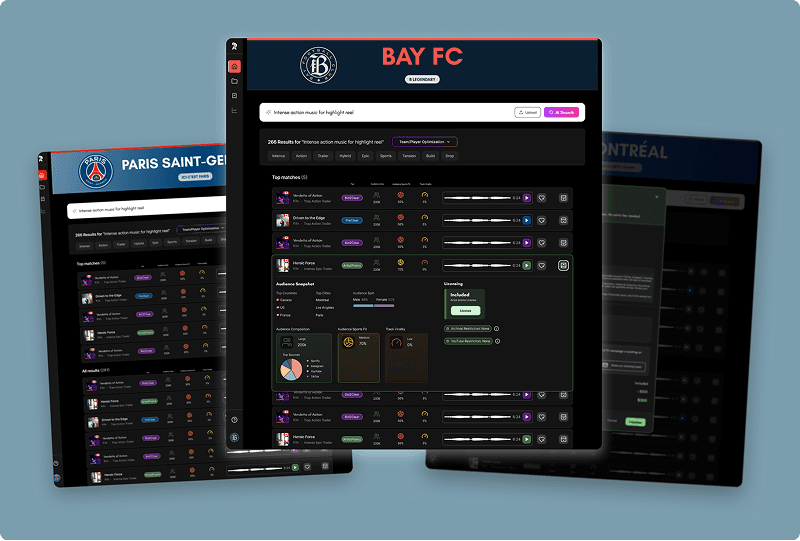
Acrylic helps sports teams discover, evaluate, and license music for social content — turning a fragmented rights process into a clear workflow.

[ Hero Product Image — Three-screen Acrylic UI ]
Project Brief
Role
Role
Lead UX / Product Designer
Scope
Scope
MVP strategy, information architecture, user flows, design system, interface design, and product narrative
Focus
Focus
Buyer-side search and discovery, project-based workflows, licensing clarity, and scalable product structure
Context
Context
Early-stage startup, evolving requirements, complex music-rights constraints, and founder collaboration
Outcome
A defined MVP direction, clearer buyer workflow, reusable interface patterns, and a stronger product story for design, development, and stakeholder alignment
Behind the Design
Making licensing feel legible.
The Challenge
Acrylic was not a simple "find a song" product. It needed to make music discovery feel intuitive while accounting for licensing complexity, business rules, content usage constraints, and a multi-step decision process inside sports and brand organizations. The challenge was to translate a messy, abstract product vision into something that felt fast, trustworthy, and easy to use.
My role was to turn that ambiguity into product structure: defining flows, organizing surfaces, shaping interface patterns, and clarifying what the MVP needed to prove first.
Acrylic was not a simple "find a song" product. It needed to make music discovery feel intuitive while accounting for licensing complexity, business rules, content usage constraints, and a multi-step decision process inside sports and brand organizations. The challenge was to translate a messy, abstract product vision into something that felt fast, trustworthy, and easy to use.
My role was to turn that ambiguity into product structure: defining flows, organizing surfaces, shaping interface patterns, and clarifying what the MVP needed to prove first.
The Breakthrough
The key was realizing that Acrylic could not simply present a large catalog of music. It needed to guide users toward confident decisions. That meant structuring the MVP around search-first discovery, clear project organization, understandable licensing paths, and a system of signals that made the product feel trustworthy without overwhelming the user.
I worked closely with the founder and technical team to turn evolving product ideas into concrete flows, reusable patterns, and a clearer information architecture. The goal was not just to make the interface look polished — it was to define a product structure that could actually support the platform’s complexity.
Flows, Structure & MVP Definition
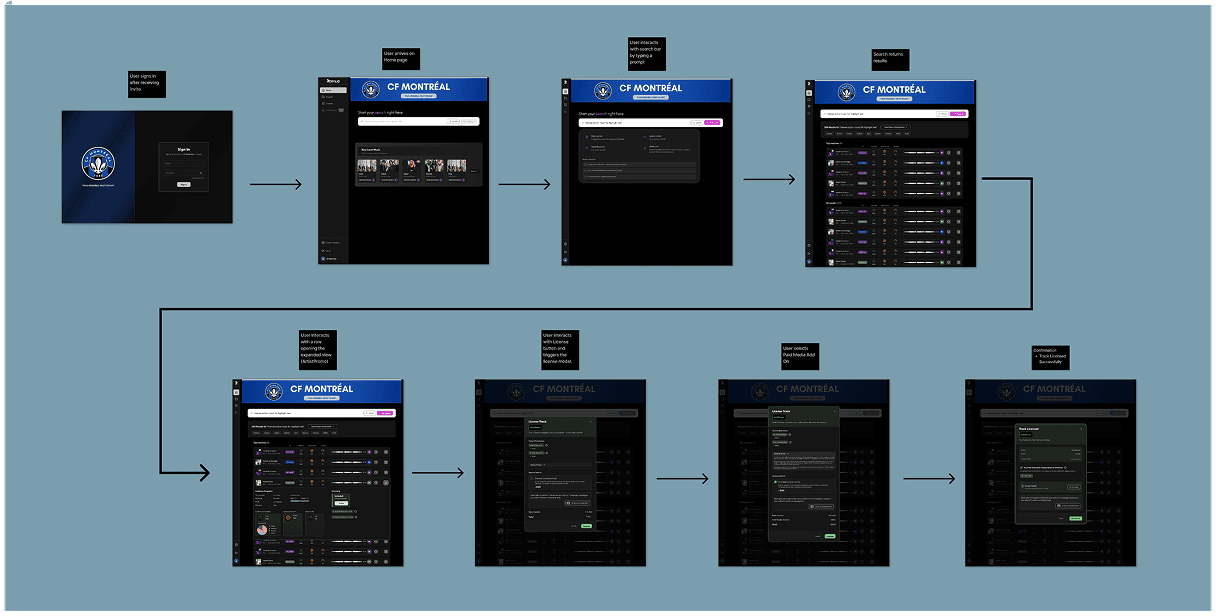
To make Acrylic actionable as an MVP, I had to define the smallest useful set of surfaces needed to support discovery, evaluation, organization, and licensing.


Core MVP flow showing how discovery, evaluation, organization, and licensing were structured into one buyer-side journey.
“Sports content moves fast.
Music rights do not.”
“Sports content moves fast.
Music rights do not.”
“Sports content moves fast.
Music rights do not.”
The product needed to close that gap without pretending the complexity disappeared.
Outcome & Impact
A clearer foundation for the MVP.
The Acrylic work helped turn an early product concept into a clearer MVP direction.
Defined the buyer-side path from discovery through licensing
Structured music-rights complexity into clearer product decisions
Created reusable patterns for search, saved work, and track evaluation
Gave the founder and development team a concrete implementation path
Established a scalable foundation for future team, artist, and rightsholder workflows
Reflection
“Acrylic was a strong example of the kind of design challenge I do my best work in: ambiguous, constraint-heavy, and strategically important. The real task was not just making screens look polished. It was finding structure inside a complex product idea, simplifying what needed simplification, and creating enough clarity for the MVP to move toward implementation.”
Continue exploring.
Continue exploring.
Continue exploring.
See more design work, or visit the Acrylic platform.
←
Back to Design & Systems
Visit Acrylic
→
© 2026 Arman Musaji
Email: